
Understanding AI Starts with Definitions, Not Technology
One question is appearing with increasing frequency in boardrooms, executive leadership meetings, and investor discussions: What’s the difference between AGI, Superintelligence, and Singularity?
Not long ago, these terms were largely confined to research labs, universities, and science fiction. Today, they are finding their way into earnings calls, strategic planning sessions, media headlines, and governance discussions.
That shift is significant. Leaders are no longer focused solely on what AI can do today. They are trying to understand what AI could mean for competitive advantage, workforce transformation, innovation, governance, and long-term strategy.
The challenge is that terms such as AGI, Superintelligence, and the Singularity are often used interchangeably despite describing fundamentally different capabilities and futures. As the conversation shifts from today’s capabilities to tomorrow’s possibilities, precision matters.
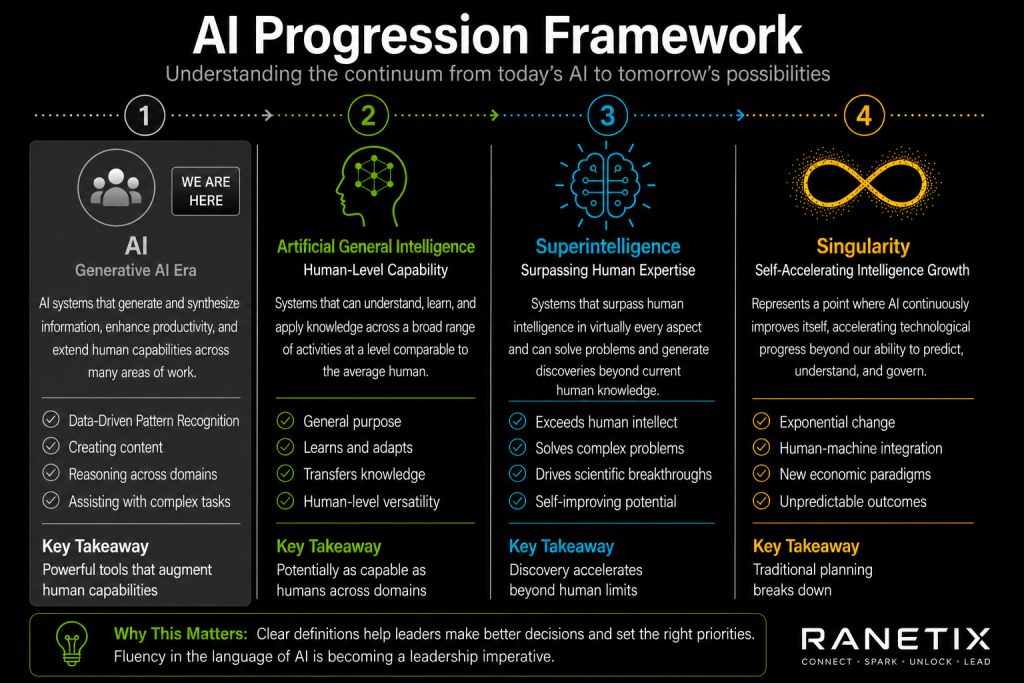
The framework below provides a simple way to think about the progression:
AI: Generative AI Era
Organizations are currently operating in the era of Generative AI. Modern AI systems can create content, analyze information, generate software, reason across domains, and assist with increasingly complex tasks. These capabilities are already creating meaningful business value and reshaping how work gets done. Yet today’s systems still require human direction, judgment, validation, and governance. They are powerful, but they are not general intelligence.
AGI: Human-Level Capability
Artificial General Intelligence (AGI) represents the point at which AI can perform most intellectual tasks at a level comparable to the average human across a broad range of domains. Rather than being highly capable in specific areas, AGI would demonstrate the flexibility and adaptability associated with human intelligence itself. For many leaders, AGI represents the first major threshold because it begins to challenge long-held assumptions about knowledge work and organizational design.
Superintelligence: Surpassing Human Expertise
Superintelligence moves beyond human-level capability. At this stage, AI would exceed the cognitive abilities of the best human experts across virtually every field. It would not simply process information faster. It could generate insights, discoveries, inventions, and breakthroughs beyond current human knowledge. The conversation shifts from productivity to transformation.
Singularity: Self-Accelerating Intelligence Growth
The Singularity is a hypothetical point at which AI continuously improves itself, accelerating technological progress beyond humanity’s ability to predict, fully understand, or effectively govern. Whether this future arrives in decades, centuries, or never at all remains an open debate. What matters is not predicting the exact timeline. What matters is understanding the potential implications if technological progress continues to accelerate.
The Question Leaders Should Really Be Asking
While debates about AGI timelines often dominate headlines, they are not the most important question for boards and executive teams. The more important question is:
How should organizations prepare for a future in which AI capabilities improve faster than organizational capabilities?
History suggests that technology is rarely the primary constraint. Leadership, governance, operating models, decision-making processes, talent strategies, and organizational readiness are often the limiting factors. Organizations that thrive will not necessarily be those that predict the future most accurately. They will be those that build the agility, governance, and adaptability to respond as the future unfolds.
Why This Matters Now
Whether AGI arrives in five years, fifty years, or never fully materializes, leaders do not need certainty to take action. They need clarity. A shared understanding of the language creates better conversations. Better conversations lead to better decisions. And better decisions position organizations to navigate uncertainty with confidence.
Most AI conversations start with technology. The best ones start with definitions.